Tables and diagrams
We’ve collected key tables and diagrams in the guide here for ease of reference.
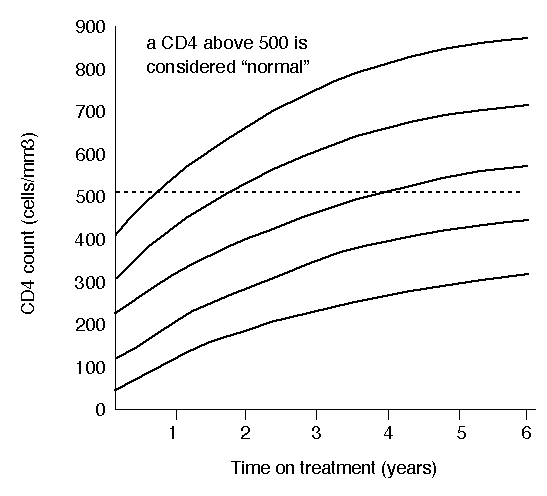
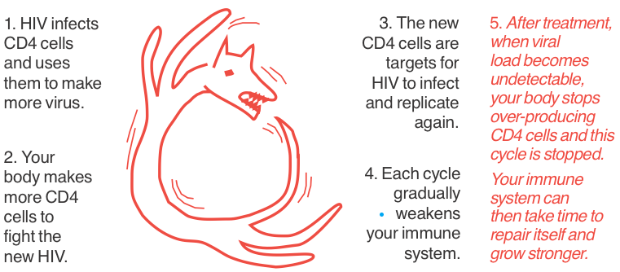
When not on treatment, your immune system works in overdrive
Average CD4 increases by starting CD4 count

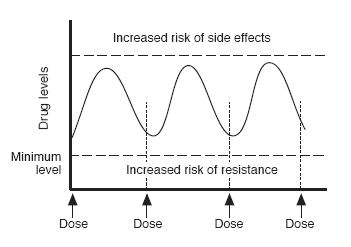
Drug levels with good adherence

Drug doses are calculated so that average drug levels are high enough to be active against HIV without risking resistance — 24 hours a day — and low enough to minimise the risk of side effects.
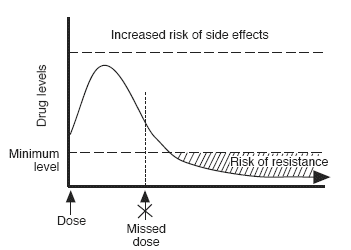
Missing or being late with a drug lets the drug levels fall to a level where resistance can develop

The more often you are late or miss a dose, the greater the chance this will occur.
The main types of hiv drugs
| RTIs or nukes | Reverse transcriptase inhibitors – also called nucleoside or nucleotide analogues |
|---|---|
| NNRTIs | Non-nucleoside reverse transcriptase inhibitors or non-nukes |
| PIs | Protease inhibitors |
| EIs | Entry inhibitors – CCR5 inhibitors are also entry inhibitors |
| INIs | Integrase inhibitors |
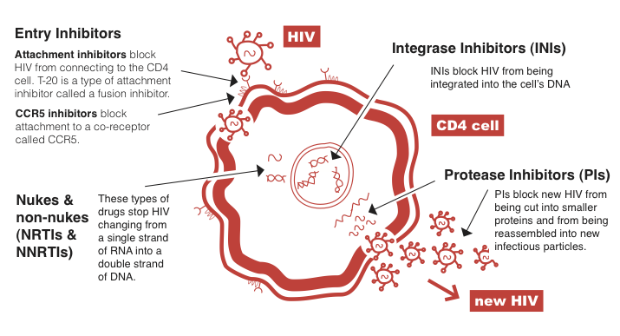
HIV lifecycle – how drugs work in different ways
Each CD4 cell is used to produce hundreds of copies of HIV. Different drugs block different parts of the HIV lifecycle.

The most commonly used first line combinations
| Drug name and comments | Side effects | Other notes |
|---|---|---|
| Efavirenz (Sustiva/Stocrin) Efavirenz is recommended as part of a first-line therapy. It is 1 pill, once-daily. Side effects, which can be significant, usually reduce after the first few weeks. |
Side effects are sleep disturbance (including nightmares), mood changes (including anxiety and depression), rash, liver toxicity and lipid changes. About 20% people either switch to another drug. | Efavirenz should not be used during pregnancy or by women trying to conceive a baby. |
| Nevirapine (Viramune)
Nevirapine is an alternative to efavirenz, but has a slightly higher risk of serious side effects. Nevirapine is started at 1 tablet a day for the first 2 weeks, and then 1 tablet twice-daily. |
Main side effects are rash and liver toxicity. These only occur in the first 6-8 weeks. Any low level rash should be taken seriously. Serious rash can be fatal. If you still have a rash after the first 2 weeks do not increase the dose. Your doctor needs to see any rash. | Women with a CD4 count over 250 and men with a count over 400 should not start with nevirapine. |
| Lopinavir/r (Kaletra)
Kaletra is widely used as a first-line protease inhibitor. It is a twice-daily drug that includes ritonavir inside the same pill. |
Main side effects are changes in lipids (blood fat) which should be routinely monitored, lipodystrophy (fat accumulation) and diarrhoea. | Kaletra includes lopinavir and ritonavir in the same pill. |
| Atazanavir/r (Reyataz)
Atazanavir/r now widely usedas first-line treatment, because it is dosed once-daily and generally easy to tolerate. |
Main side effects are yellowing eyes or skin in 10% of patients. This is not a problem unles total bilirubin levels increase to 60-70 mmol/L. Lipids can increase due to the use of ritonavir. | Taken with a separate dose of ritonavir (/r), unless you have high drug levels. |
| Fosamprenavir/r (Telzir)
In studies fosamprenavir/r had similar results to Kaletra, but is less commonly used. |
Side effects, including diarrhoea and lipids are similar to Kaletra. | Taken with a separate dose of ritonavir (/r). |
| Saquinavir/r (Invirase) Saquinavir/r has shown similar results to Kaletra. There is less comparative data to Kaletra than for fosamprenavir/r. |
Side effects, including diarrhoea and lipds are similar to Kaletra. May have a lesser effect on trigliceride levels. | Taken with a separate dose of ritonavir (/r). |
| Darunavir/r (Prezista)
Approved in February 2009 as a once-daily first-line PI. |
When compared to Kaletra, darunavir had lower rates of nausea, diarrhoea and lipid changes | Taken with a separate dose of ritonavir (/r). |
Each option is used with either Truvada (tenofovir + FTC) or Kivexa (abacavir + 3TC).