
Resistance tests
 A resistance test shows whether your current meds are still active. The test doesn’t always tell you about previous drugs.
Drug resistance involves small changes to the structure of HIV. These changes are called mutations.
For example, the mutation called M184V will stop 3TC and FTC from working. It also makes abacavir less active.
The mutation E138A stops the NNRTI rilpivirine from working. Other common NNRTI mutations include K103N and Y181C.
Integrase inhibitor mutations include N155H and Q148H/R/K.
More complicated results need to be interpreted by an expert.
UK guidelines recommend a resistance test before changing treatment. You need to have blood taken while you are still on the failing ART.
There are two main types of drug resistance tests. See Figure 8 below.
Figure 8: Types of resistance tests
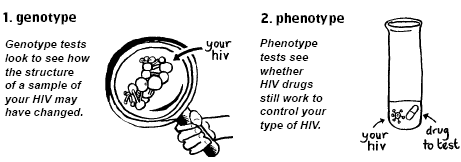
Resistance tests can only detect resistance to drugs that you are currently taking. They might also work for recent drugs. A ‘virtual phenotype’ test compares results from your genotype test to a large database of phenotype results. This then predicts your phenotype.
Genotype tests (mutation changes)
Genotype resistance tests are the only type of test that is likely to be used in the UK.
A genotypic resistance test looks at the structure of your virus and how it has changed from normal ‘wild-type’ virus. Different changes are associated with resistance to different drugs.
This gives a good idea of which drugs will not work.
This will help to choose drugs for your next ART.
Results should take about a week.
Genotype tests cannot show which drugs will definitely work. But they can show which drugs WILL NOT work. This information is just as important.
Phenotype tests (‘fold’ changes)
Phenotypic test are now rarely used in the UK.
These tests look at whether different drugs are active against HIV in a test tube. The results shows how active each drug is.
Results tell you how much of a drug is needed compared HIV without resistance. Detailed results are given as “fold” changes. For example, 2-fold resistance means the drug is only half as effective. 5-fold resistance means it is only 20% effective.
Interpreting phenotype tests is complicated. Each drug has a different range where they might still be working. Results are simplified to say whether your HIV is still sensitive, partially active, or resistant to each drug.
Phenotype tests are only used when genotype results do not give a clear result.
Phenotype tests are more expensive. They take longer to get results (usually 2–4 weeks). This is because it takes time for the virus to grow.
Virtual phenotype tests
The “Virtual Phenotype” test compares results from a genotype test to those in a large database of matched phenotype results.
This test is therefore not really a phenotype test but can still be useful.
These tests are no longer used.
Last updated: 1 January 2025.