
Insomnia – disturbed sleep
Associated drugs: efavirenz, TLE (contains efavirenz), dolutegravir, TLD (contains dolutegravir), Triumeq (contains dolutegravir), bictegravir and Biktarvy (contains bictegravir).
Sleep problems as a side effect
The main modern HIV drugs that affect sleep are dolutegravir and bictegravir. However, only about 1 in 20 people (5%) report this problem.
Taking these drugs in the morning or during the day rather than at night can reduce insomnia.
Efavirenz causes difficult mood changes and these can disturbs sleep and cause vivid dreams.
Luckily, this drug is now rarely used.
Efavirenz needs to be taken at night so you sleep during the mood changes. It should not be taken within two hours of a high fat meal as this will increase drug levels. If you are still using efavirenz and have side effects it is better to change to a different drug.
Other causes of poor sleep
Sleep problems though are common in people living with HIV, but these are often not directly related to either HIV ir HIV meds.
This is always important enough to tell your doctor. We all need regular, good quality sleep. Sleep is an essential part of a healthy life. It is a time when your body is able to rest and repair.
Good sleep affects how we think, speak and concentrate on daily activities. So not sleeping well can affect all these things. We can quickly become irritable. We have slower reactions, and our memory and judgement will be affected.
Sleep problems are generally under-reported, under-diagnosed and under-treated. Keeping a sleep diary for the week before you see your doctor can help diagnose some of the problems.
Insomnia is more often related to depression than a side effect of HIV treatment. One study reported that 1 in 3 people living with HIV had symptoms of depression. In 40% of cases this was not being treated.
Our psychological health relates closely to our physical health.
Factors affecting sleep include:
- Problems falling asleep at night.
- Waking up too early in the morning.
- Waking throughout the night and only getting intermittent sleep.
A sleep diary can include when you fall asleep and when you wake up – on weekdays and weekends. Include any naps you have during the day.
- Record how you feel about the general quality of your sleep, including vivid dreaming or nightmares.
- Record drug and alcohol use -– or changes in use such as withdrawal or cutting back on either.
- Caffeine in tea, coffee and cola can affect your ability to sleep, even many hours before you go to bed. Keep a record of how much caffeine you drink during the day and see if changing to a non-caffeine alternative helps.
- Include details about your sleep environment. How comfortable is your bed? Is the room warm and quiet?
- Include when you normally eat. Leaving a couple of hours between your last meal and going to sleep will improve the chance of better sleep.
- Stress and worry can easily disrupt your sleep pattern, as can ongoing health concerns, especially if they are painful or uncomfortable.
- Include screen time on mobile phones and other screens. Cutting back on screen time for the hour or two before you sleep can often help.
Your doctor should also give you a physical check up and blood tests to check for cardiovascular, respiratory or hormonal reasons, especially thyroid function, that might be causing sleep disturbance.
Getting a referral for support for depression, including treatment if appropriate, might help with sleep problems.
EACS guidelines: Tests to check for a referral
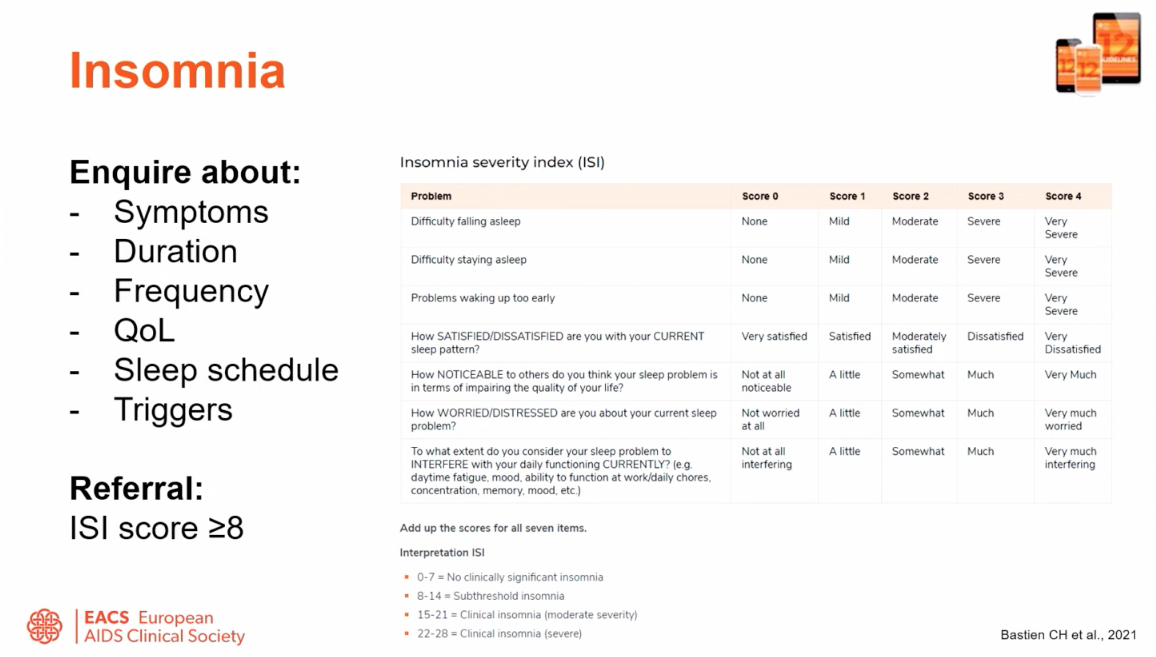
Insomnia Severity Index (click for large view)
European HIV guidelines produced by EACS include three simple tests that your doctor can use to assess how poor sleep is affecting your life. [1]
These short validated screening tools are then recommended for insomnia, excessive daytime sleepiness and sleep apnoea when abnormal symptoms are reported.
The Insomnia Severity Index (range 0 to 28) involves seven questions that cover sleep quality and impact on quality of life, with a five-point scale and a score >7 to prompt further referral.
The Epworth Sleepiness Scale (range 0 to 24) asks likelihood of sleeping in eight situations, with a 3-point rating and a score >10 prompting referral.
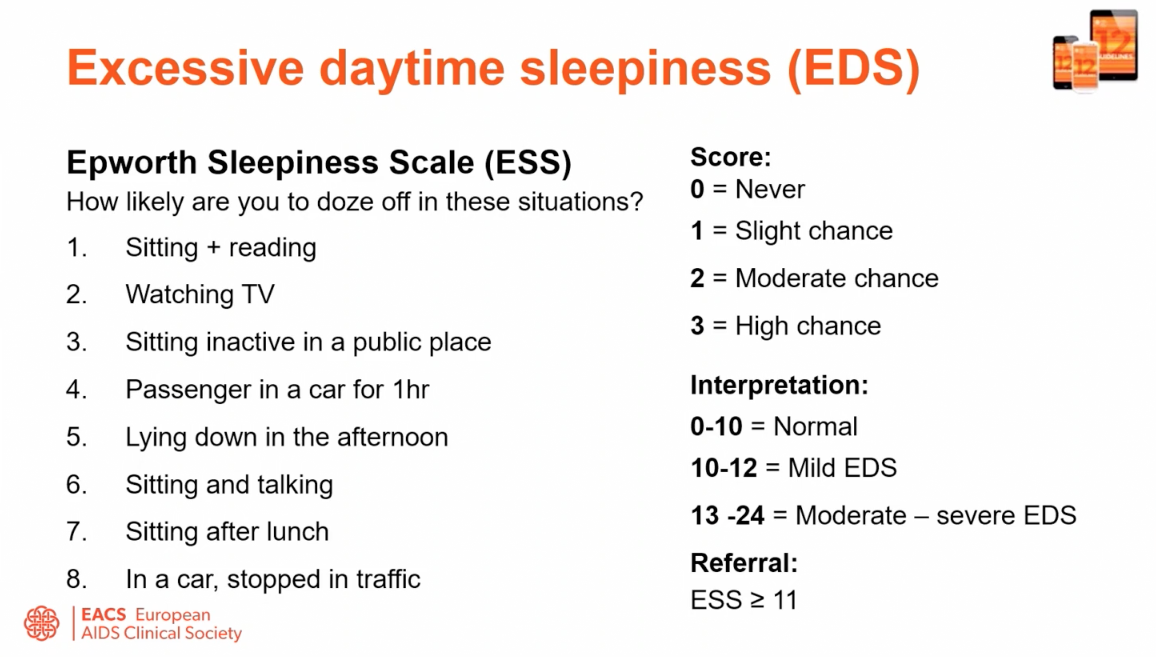
Epworth Sleepiness Scale (click for large view)
Lastly, the STOP-BANG questionnaire (range 0 to 8) uses eight questions (with yes/no answers) and a score >2 indicating moderate risk to prompt referrals.
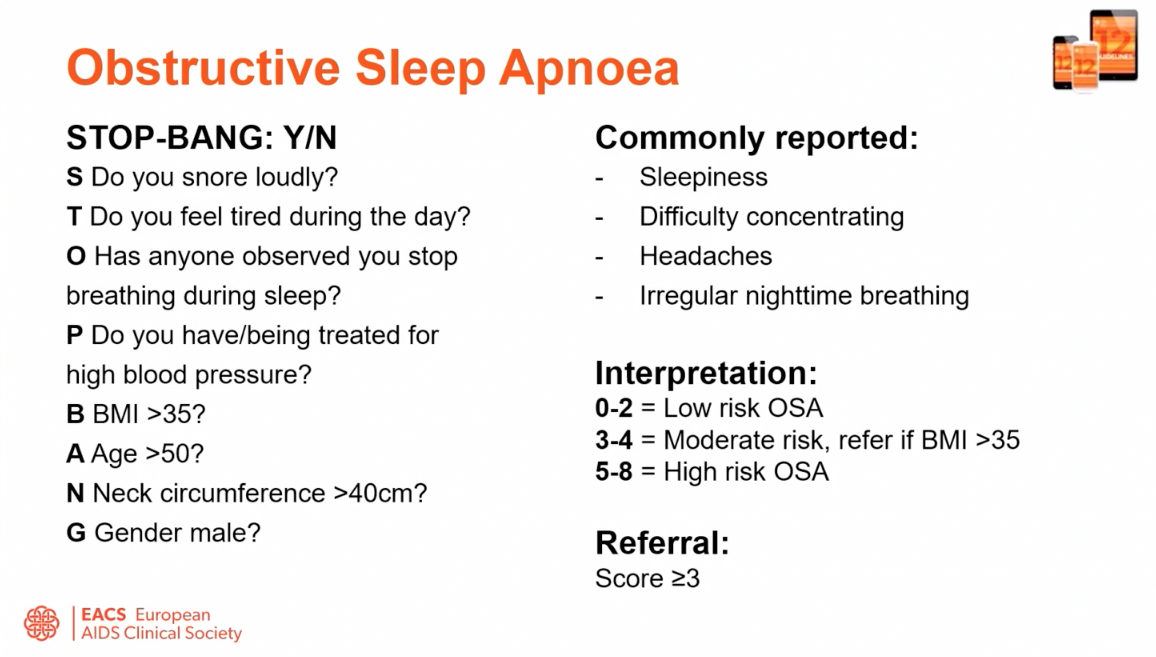
STOP-BANG questionnaire (click for large view)
The guidelines also include identifying modifiable risk factors, including:
- Mental health (depression, anxiety).
- Alcohol excess and recreational drug use.
- ART considerations:
- avoid efavirenz-based regimens in those with symptoms of poor sleep.
- dose second-generation integrase inhibitors in the morning rather than evening.
- Review concomitant medication for drugs which may cause sleepiness, such antihistamines, benzodiazepines, antidepressants, opioid pain medication, muscle relaxants and some blood pressure medication.
- Weight and body habits review and advice on diet and exercise.
- Suboptimal sleep habits.
The EACS guidelines are now hosted on the Stanford website and are no longer produced in print or PDF format.[2]
The section on sleep health is included in the section on complications, together with information on cognition, mental health and substance use. [3]
References
- EACS guidelines. Special session. Thursday 22 October 2025 (5.30 am).
https://player.vimeo.com/video/1128297512?h=b4f77cca47&title=0&byline=0&portrait=0&badge=0&autopause=0&player_id=0&app_id=58479 - EACS Guidelines 2025. Versions 13.0, October 2025.
https://eacs.sanfordguide.com - EACS guidelines. Sleep disorders. (October 2025).
https://eacs.sanfordguide.com/en/eacs-part2/eacs-cognition-mental-sleep-health-substance-use/sleep-disorders
Medication
Sleeping pills are only usually prescribed when other self-help remedies have been tried. They are used to help re-establish a pattern of sleeping. They are not recommended or generally prescribed for long-term use.
Sleeping tablets should only be used for a short period and at the lowest dose.
All sleeping pills work in a similar way by reducing brain activity, but the type of sleep they produce varies between different types of drug. They can help you sleep, but the depressed brain activity means that the quality of sleep is often not as good as natural sleep, and you might still not feel rested the next day.
Sleeping pills reduce the amount of ‘dream sleep’ that you get which is an important component of good sleep. Sometimes this can leave you feeling drowsy the next day. They can become less effective after even a few days’ use, and you can develop a physical or psychological dependency if they are used for more than 1–2 weeks.
Although benzodiazepines (ie temazepam) have relatively few side effects they can interact with protease inhibitors.
Non-benzodiazepines such as zopiclone and zolpidem work in a similar way, are shorter acting, and are preferred when anxiety is not a contributing factor.
Melatonin is a hormone produced at night linked to your ‘biological clock’. As a supplement it is used to help deal with jet lag and might help return sleep patterns to normal, although side effects include vivid dreams.
Suggestions to help
It is important that the causes of insomnia are diagnosed before any treatment is given.
The wide range of causes mean that non-pharmaceutical approaches, such as having a warm bath or hot milky drink before bedtime, can often make a big difference and are sometimes sufficient.
Do…
- Sleep only enough to be refreshed.
- Get into a routine where you can go to sleep and wake up at the same time each day. Waking up earlier might help.
- Try to exercise every day.
- Avoid extremes of noise or temperature.
- Drink chamomile or other herbal teas.
- Make your bedroom as comfortable and relaxing as possible.
- Limit screen time on mobile phones and other screen. The brightness of the screen over-activates your brain rather than preparing it to rest.
- Eat an evening meal so that you are not hungry when you go to bed.
- Try burning oils.
Don’t…
- If you use sleeping pills, don’t use them every night.
- Drink caffeine drinks or alcohol before bedtime as this will reduce the chance of sleeping well.
- Smoke close to bedtime – it makes sleeping difficult.
- Don’t use your mobile phone and other screens before you sleep or in bed – or cut this back to a minimum.
- Don’t nap during the day, so that you are more tired at night when you need to sleep..
Sleep problems from efavirenz (Sustiva, Atripla) or rilpivirine (Eviplera)
Last updated: 1 July 2026.