

CROI 2026: Once-daily oral BIC/LEN simplifies ART for those on complex combinations
25 February 2026. Related: Conference reports, Antiretrovirals, CROI 33 (Retrovirus) 2026.

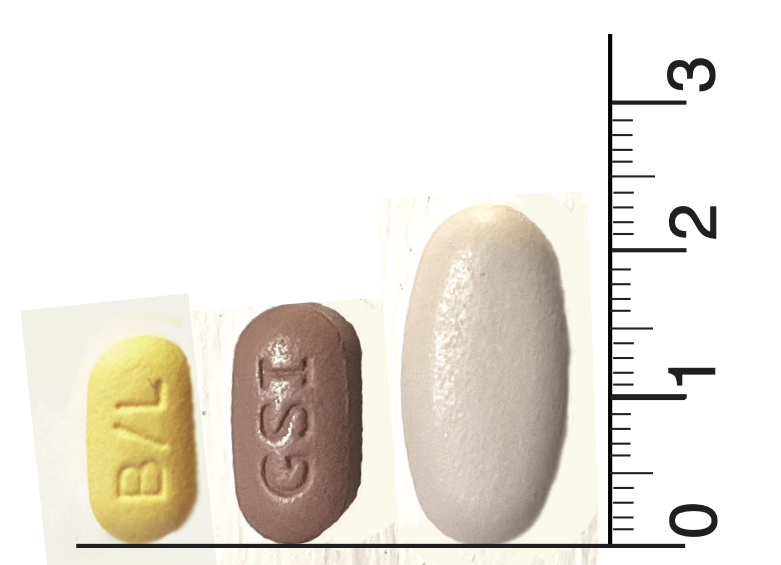
BIC/LEN – Biktarvy – Triumeq (cms)
Simon Collins, HIV i-Base
Several studies at CROI 2026 presented results from a new combination in a tiny oral pill that has the potential to simplify daily ART for people with complicated combinations linked to earlier drug resistance or side effects.
This included results from the two large phase 3 ARTISTRY-1 and -2 studies.
ARTISTRY-1: BIC/LEN switch from complex ART
ARTISTRY-1 was presented by Professor Chloe Orkin from Queen Mary University of London in an oral session. [1]
This open-label, non-inferiority, international study randomised (2:1) 557 people who were undetectable on more complex ART to either switch to once-daily bictegravir/lenacapavir (BIC/LEN) 75 mg/50 mg (n=371) or remain on their current ART (n=186). Just under half of participants were from the US and one-third was from Europe. The primary endpoint was the percentage of participants with detectable viral load >50 copies/mL) at week 48.
This was a very treatment-experienced cohort with median 28 years on ART (IQR: 22 to 32).
Other baseline characteristics included median age 60 years (range: 22 to 84, with 77% >55 years old), 82% men/18% women (at birth), 97% were cisgender, with 4 transgender, 4 non-binary and 9 not disclosed. 69% were white, 17% Black, 4% Asian and 3% other.
Median CD4 count was 612 cells/mm3 (456 to 809) with only 17 participants having <200 cells/mm3.
The definition of complex regimens for the current ART included using three or more ARV classes, needing more than once-daily dosing or taking more than two oral tablets daily.
Approximately 80% of participants had drug resistance documented for at least one class and 30% had intolerance or contraindications to one or more drugs in other combinations. Participants were taking a median of 3 drugs (range 2 to 6) and 3 tablets (range 2 to 11) in complex combinations with 41%, 26%, 11% and 22% taking 2, 3, 4 and 5 or more daily ARV pills respectively. Overall, 39% were taking twice-daily combinations). See Table 1.
Table 1: Examples of baseline combinations in ARTISTRY-1
| PI + INSTI | cobicistat + darunavir + dolutegravir | 30% | n=166 |
| PI + INSTI + NRTI | cobicistat + darunavir + dolutegravir + emtricitabine + tenofovir alafenamide | 24% | n=135 |
| INSTI + NNRTI (± NRTI | bictegravir + doravirine + emtricitabine + tenofovir alafenamide | 13% | n=73 |
| PI + INSTI + NNRTI (± NRTI) | darunavir + etravirine + raltegravir + ritonavir | 12% | n=69 |
| Other | 7% | n=41 | |
| PI + INSTI + EI (± NRTI) | darunavir + etravirine + maraviroc + ritonavir | 4% | n=23 |
| PI + NNRTI (± NRTI) | darunavir + dolutegravir + maraviroc + ritonavir | 3% | n=17 |
| INSTI + EI + NNRTI (± NRTI) | etravirine + maraviroc + raltegravir | 4% | n=20 |
| INSTI + EI (± NRTI) | lamivudine + abacavir + dolutegravir + maraviroc | 3% | n=16 |
Most participants (80%) were taking one or more other medications, mainly to control lipids (715), blood pressure (55%) and diabetes (23%). Kidney function was generally good with eGFR >60 in 85%, <30 to <60 in 15% and 6 participants were >15 to <30 mL/min.
At week 48, the primary endpoint of detectable viral load was reported in 3 vs 2 participants in the BIC/LEN vs control arms respectively (difference −0.3%; 95% CI −2.3 to 1.8) meeting the non-inferiority margin of 4%. No drug resistance was reported.
Viral load was <50 copies/mL in 96% vs 94% in the BIC/LEN vs control arms, with no data available for 12 (3%) vs 10 (5%) participants, respectively.
Tolerability and side effects were similar in both arms but with improved lipid profiles from BIC/LEN, largely driven by the switch away from use of boosted protease inhibitors.
Grade 3 or higher events were reported by approximately 14% of participants in each arm but drug-related events were reported for only three participants in the BIC/LEN arm (diabetes and maculopapular rash). None of the five deaths in the BIC/LEN arm were related to the study drugs. Participant preference was higher for the BIC/LEN arm.
Although the median CD4 changes were +18 vs –12 cells/mm3 in the BIC/LEN vs control groups, the range was similar between arms and the difference was not statistically significant (p=0.22).
Longer-term 96-week results from the earlier phase 2 part of the ARTISTRY-1 study were presented as a poster at the meeting. [2]
ARTISTRY-2: BIC/LEN vs B/F/TAF control
The related phase 3 ARTISTRY-2 study was presented as a poster at CROI by Eric Meissner from University of South California and colleagues. [3]
This study had a similar design and endpoint but enrolled 574 people who were already undetectable for at least 6 months on B/F/TAF Biktarvy.
Baseline characteristics included median age 49 years (range: 23 to 77), 19% of participants were female, 27% were Black and 27% were Hispanic or Latine.
The primary endpoint results at week 48 reported 1.3% (5/383) vs 1.0% (2/191) on BIC/LEN vs B/F/TAF respectively meeting the noninferiority margin (0.3% [95%CI: –1.9% to +2.4%]).
Undetectable viral load (<50 copies/mL) was reported in 93% vs 90% respectively.
comment
These results are welcomed and will be used to submit for regulatory review, which is expected shortly.
The low doses needed for BIC/LEN might make this even smaller than Biktarvy, which will also improve quality of life and participant acceptability.
Hepatitis B was an exclusion criteria for both studies, although one case of HBV reactivation led to a discontinuation on ARTISTRY-1, and this lack of HBV coverage will be a practical consideration outside of clinical settings, and might vary in different countries.
Results from ARTISTRY-1 were simultaneously published as an open-access paper in the Lancet. [4]
An accompanying editorial highlighted the importance of simpler combinations, especially for people with such extensive treatment histories and complex combinations. [5]
It also noted that most study participants were from North America (48%), Europe (33%) and Australia (7%), leaving only 12% (n=70) coming from Asia, Africa, and South America (and only 6 from sub-Saharan Africa). Sometimes this can be due to practical issues but this raises the issues of equity of access in some countries and clinic sites and also the need for additional studies in more diverse regional populations.
References
- Orkin CM et al. Phase III Efficacy and Safety of Switch From Complex Regimen to Single-Tablet BIC/LEN in ARTISTRY-1. CROI 2026, Denver. Oral abstract 181.
https://www.croiconference.org/abstract/2302-2026 (abstract)
https://www.croiwebcasts.org/console/player/55172 (webcast) - Hedgcock M et al. Switch to BIC+LEN in Virologically Suppressed People With HIV on Complex Regimens: Week 96 Outcomes. CROI 2026, Denver. Poster abstract 518.
https://www.croiconference.org/abstract/1325-2026 (abstract and poster) - Meissner M et al. Phase III Efficacy and Safety of Switch From B/F/ TAF to Single-Tablet BIC/LEN in ARTISTRY-2. CROI 2026, Denver. Poster 513.
https://www.croiconference.org/abstract/2367-2026 (abstract, poster and webcast) - Orkin CM et al. Switch to single-tablet bictegravir–lenacapavir from a complex HIV regimen (ARTISTRY-1): a randomised, open-label, phase 3 clinical trial. The Lancet. DOI: 10.1016/ S0140-6736(26)00307-7. (25 February 2026).
https://www.thelancet.com/journals/lancet/article/PIIS0140-6736(26)00307-7/fulltext - Saag MS. Managing complex antiretroviral regimens. Lancet editorial. (25 February 2026). Open access with free registration.
https://www.thelancet.com/journals/lancet/article/PIIS0140-6736(26)00364-8/abstract