

AIDS 2026: Activists challenge US government’s claims to manage PEPFAR
27 July 2026. Related: Conference reports, Treatment access, Activism & advocacy, Intl AIDS 26th Rio 2026.
 Simon Collins, HIV i-Base
On 26 July 2026, a community protest just ahead of the International AIDS Conference highlighted the impact that the changes US funding policy have had on global health. [1]

Protesters at AIDS 2026
The protest was led by activists from Health GAP, Treatment Action Campaign and Housing Works, who challenged the “turmoil” caused by the Trump administration’s “unprecedented attacks on HIV funding, science and the human rights of people most affected by HIV”. [2]
They disrupted a session organised by the US government, interrupting speaker Jeff Graham. Graham is the acting US Global AIDS Coordinator responsible for PEPFAR and the head of the US delegation to the conference.

Although this early morning meeting itself was poorly attended by delegates, giving a platform to the current US administration had already drawn criticism from more than 100 community organisations who had signed on to an open letter to IAS the previous week. [3]
This letter highlighted that the theme of AIDS 2026 – “Rethink. Rebuild. Rise.” – was itself only needed because of the way in which the US government had gone about changing policy.
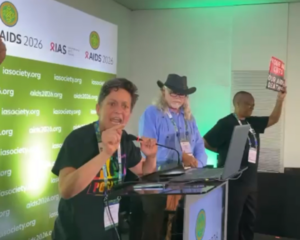
Asia Russell speaks to US government officials at the conference
Asia Russell, executive director and founder of Health GAP, directly addressed Graham and other speakers: “We will not be erased. PEPFAR’s own programme data show the deadly harms of this approach. Your own data show it – although you have repressed it.”

As expected, the presentations after the protest attempted to justify current US policy as being a progressive plan to support global responses to HIV. However, these arguments were presented without supportive evidence, and claimed that continued reduced US support was a progressive way to restructure international aid.
It is unlikely that many in the audience were convinced, especially as two studies presented at AIDS 2026 as part of an early press conference included examples of the destructive impact of changes to PEPFAR funding.
The first reported results were of a survey of more than 150 implementing partners in 46 countries, who reported on the closure of more than 1700 health clinics and changes in provision that actively targeted people from key populations affected by HIV. Changes included more than 1 in 5 services reporting reduced access to ART or cancelled prevention programmes that withdrew access to condoms and PrEP. [4]

The second study described the changes in services to children living with HIV, which included reduced access to testing, monitoring and treatment for this group in 2025 compared to 2024. [5]
This included that PEPFAR provided ART to 77,000 fewer children last year, a likely direct impact of reduced testing and monitoring, reported in the CHAI Market Analysis report for June 2026. [6]
All abstracts from AIDS 2026 now appear to be accessible online, ahead of the previously reported Monday embargo.
References
- Transforming health assistance: Implementing U.S. government MOUs for sustainable HIV programs. Pre-conference satellite meeting. 26 Jul 2026, Rio de Janeiro.
- Health GAP. Activists Disrupt U.S. Global AIDS Coordinator Jeff Graham at International AIDS Conference Protesting Trump’s Chokehold on Congressionally Appropriated HIV Funding Mass Closure of Key Population Programs and Attacks on Transparent Oversight of PEPFAR Programs. (26 July 2026).
https://healthgap.org/press/activists-disrupt-u-s-global-aids-coordinator-jeff-graham-at-international-aids-conference-protesting-trumps-chokehold-on-congressionally-appropriated-hiv-funding-mass-closure-of-key-popul - Mattioli S. Open letter to the leadership of the International AIDS Society on the inclusion of the “America First Global Health Strategy” in the AIDS 2026 pre-conference programme.
https://www.sandromattioli.eu/wp-content/uploads/2026/07/Open_Letter_IAS_AIDS2026_EN.pdf - Lankiewicz E et al. Measuring PEPFAR disruptions at scale: Results from a 46-country implementing partner survey. Late-breaking oral abstract OAX1103LB.
https://programme.aids2026.org/Abstract/Abstract/?abstractid=12711 - Godbole R et al. Shifts in PEPFAR-supported pediatric treatment: rapid analysis of fiscal year 2025 PEPFAR program data. Late-breaking oral abstract OAF2506LB.
https://programme.aids2026.org/Abstract/Abstract/?abstractid=12679 - CHAI reports impact of cuts in HIV CD4 and viral load testing reduced PrEP: children fare worst. HTB (9 June 2026).
https://i-base.info/htb/54042